Showing posts with label Mould Inspection. Show all posts

Wednesday, 7 March 2012

Efflorescence

Efflorescence is an accumulation of minerals and salts on masonry surfaces, such as brick, cement, and sometimes stone. Efflorescence itself is not dangerous; it indicates the presence of excess water, which can lead to more serious structural and health issues.


How Efflorescence Forms

The earth contains natural salts that are present in the raw materials that make up masonry products, such as concrete, asphalt and stucco. These salts remain trapped within masonry in solid form until they are dissolved into water, which usually makes its way into the material through small pores. Water can originate from rain, sprinklers, household leaks, or any number of other places. Cold, dry air will draw this liquid back out of the material where it evaporates, depositing the salt as a white crystalline growth on the surface. Efflorescence typically forms during cold, dry weather shortly after it has rained and moisture has entered the masonry. It can occur year-round, but it is most likely to form during the winter due to low temperatures.

As with mould, the appearance of efflorescence varies greatly. It can be powdery, it can have sharp edges and be easy to spot, or it can have indistinct edges. It can cover a large area as a fine dust, or form large individual crystals. Its appearance depends partly on the type of salt from which it is composed, but humidity also plays a role in this determination. In exceptionally dry climates, water can evaporate before it even reaches the surface, in which case the salt will accumulate unseen beneath the surface. In humid conditions, moisture may take a long time to evaporate, allowing the slow growth of “whispers” projecting from the surface.


Inspectors should note the presence of efflorescence in their inspection reports because it generally occurs where there is excess moisture, a condition that also encourages the growth of mould. An exception can be made during the first few years of a building’s construction when efflorescence will appear as a result of moisture locked within the masonry in a process called “new building bloom.” This moisture comes from water added during the manufacturing or mixing process that will undoubtedly contribute to efflorescence. This type of efflorescence will appear all over the masonry material and will continue to accumulate until the initial water supply is exhausted, which can take up to a year. Efflorescence that appears locally and after the “new building bloom” is over is a symptom of excess moisture that can be problematic. The source of this moisture should be determined and corrected.

In summary, efflorescence is a harmless yet unsightly accumulation of salts on masonry surfaces. Its presence indicates excess water, a condition that can damage interiors and encourage the growth of mould. Inspectors should know how to remove efflorescence from surfaces, and educate their clients about its identification and significance.

Wednesday, 1 February 2012

Cabinet Drawers and Slides


The kitchen is an important aspect to the home inspection process and is usually a top priority for our clients.  The kitchen is the hub of a home and is where most families spend the majority of their time.  This post will focus on the different types of drawers and drawer slides found in common North American kitchens and how they compare with each other.  

Drawers in lower cabinets improve both accessibility and usable storage volume of the cabinet. Materials and construction vary considerably depending on the quality and price of the kitchen. Melamine on particle board sides usually with nailed corners are commonly used in mass produced kitchens. These are the least expensive available and are normally used with roller & track or side mount slides. This combination allows the drawer to be pulled out only part way from the cabinet leaving approximately one quarter of the drawer hidden in the cabinet. Most slide manufacturers will provide full extension slides at a slightly higher price.  Full extension slides allow the drawer to fully extend beyond the cabinet and make the rear of the drawer more accessible.
Side mount slides.

Standard roller & track style slides.


A step above the melamine/particle board drawer is a Russian/Baltic birch drawer.  These are also nailed together and are commonly built using dado construction.  These drawers can be used with roller & track style slides, side mount slide and under mount European style slides.

Russian/baltic birch drawer with European under mount slides.
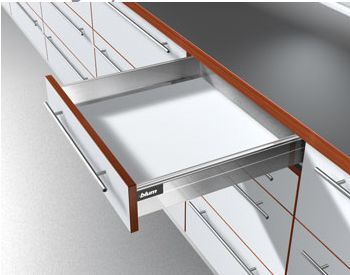
European drawer design has evolved using metal and plastic and since 1990 have become increasingly popular in North America. German innovation has brought about a different breed of drawers with space saving full extension under mount self closing non slamming push to close push to open mechanisms. Some of these are available integrated into the sides of the drawer to make an easily cleaned smooth faced combined drawer slide and drawer side.

European style drawers. 'Blum tandem box'
However the most durable drawer design is still the traditional dovetail jointed hardwood drawer. Most bespoke cabinet making companies now offer these drawers with the European under mount slide systems providing durability and function.  

Dovetail drawer with soft close under mount slides.
Another popular feature in a kitchen is a full height pantry cabinet with a combination of upper shelves and lower drawers up to almost eye level that gives much better access to items at the back of the cabinet.

Pantry with dovetail drawers on under mount slides.
Drawers may not seem to be that important to the home inspection process or the overall look of the kitchen, but they are an integral part to the overall function of the kitchen.  Considering the amount of time families spend in the kitchen, we believe having properly functioning drawers is just as important as the look of your kitchen. 


Saturday, 7 January 2012

MOULD....it all starts with WATER!

Mould is a naturally occurring organism that grows in buildings where the moisture, air, a food source, and temperature all meet the conditions for growth. Mould is everywhere, indoors and outdoors and not all moulds are bad mould. If mould levels indoors the house are higher than levels found outside the house, the house air could be compromised and reasons for concern may apply.


Mould inside a home is generally caused by some form of water intrusion. Since some moulds only need 24-48 hours to start growing, finding the source of the water intrusion and eliminating this source should be top priority in reducing the growth of mould indoors.  

If you suspect mould in your home, you may want to consider a mould inspection to further evaluate the possible problem. This home inspection process includes sampling, which is an effective method to assist and determine the scope of the problem and to understand what areas of the property have been impacted.