Saturday, 11 February 2012

Windows

This is just a quick post about window installations.  These photos are from a reno-inspection and as you can see the trim is not installed, which allows us to see how the contractor installed these windows and the products he used.

Nicely Done!
This contractor used a roofing product called ‘Ice & Water Shield’ to wrap the framing of the window opening.  This product is generally used on roofs as an underlay for the first 36” of your roof; designed to protect against ice damning and the damage it causes.  It’s a great product and works great to protect the framing around your windows. 

The sill. Where most moisture problems occur.

Ice & Water Shield.
The building code states that you only need to use 6mm poly (standard vapour barrier) on the sill and sides of the framing.  Its good practice to consider the building code as a set of minimum standards, there’s no reason why you can’t exceed those minimums. 

Anyhow, I figured I share these photos....On most home inspections we cannot see behind the finished trim and there is no way to know exactly how the windows were installed as far as the products used.

House CSI

Monday, 6 February 2012

Three Deadly Mistakes Every Home Buyer Should Avoid


This is a great article from InterNachi that is great for anyone thinking about purchasing a house!

Deadly Mistake #1: Thinking you can't afford it. 
  
Many people who thought that buying the home they wanted was simply out of their reach are now enjoying a new lifestyle in their very own homes.  Buying a home is the smartest financial decision you will ever make.  In fact, most homeowners would be broke at retirement if it wasn't for one saving grace -- the equity in their homes.  Furthermore, tax allowances favour home ownership. 

Real estate values have always risen steadily.  Of course, there are peaks and valleys, but the long-term trend is a consistent increase.  This means that every month when you make a mortgage payment, the amount that you owe on the home goes down and the value typically increases.  This "owe less, worth more" situation is called equity build-up and is the reason you can't afford not to buy. 
  
Even if you have little money for a down payment or credit problems, chances are that you can still buy that new home.  It just comes down to knowing the right strategies, and working with the right people.  See below. 
  
Deadly Mistake #2: Not hiring a buyer's agent to represent you. 

Buying property is a complex and stressful task.  In fact, it is often the biggest, single investment you will make in your lifetime.  At the same time, real estate transactions have become increasingly complicated.  New technology, laws, procedures, and competition from other buyers require buyer agents to perform at an ever-increasing level of competence and professionalism.  In addition, making the wrong decisions can end up costing you thousands of dollars.  It doesn't have to be this way! 

Work with a buyer's agent who has a keen understanding of the real estate business and the local market.  A buyer's agent has a fiduciary duty to you.  That means that he or she is loyal only to you and is obligated to look out for your best interests.  A buyer's agent can help you find the best home, the best lender, and the best home inspector in your area.  That inspector should be an InterNACHI-certified home inspector because InterNACHI inspectors are the most qualified and best-trained inspectors in the world.
Trying to buy a home without an agent or a qualified inspector is, well... unthinkable. 

Deadly Mistake #3: Getting a cheap inspection. 
  
Buying a home is probably the most expensive purchase you will ever make.  This is no time to shop for a cheap inspection.  The cost of a home inspection is small relative to the value of the home being inspected.  The additional cost of hiring a certified inspector is almost insignificant by comparison.  As a home buyer, you have recently been crunching the numbers, negotiating offers, adding up closing costs, shopping for mortgages, and trying to get the best deals.  Don't stop now!  Don't let your real estate agent, a "patty-cake" inspector, or anyone else talk you into skimping here.  

InterNACHI front-ends its membership requirements.  InterNACHI turns down more than half the inspectors who want to join because they can't fulfill the membership requirements. 
InterNACHI-certified inspectors perform the best inspections, by far.  InterNACHI-certified inspectors earn their fees many times over.  They do more, they deserve more and -- yes -- they generally charge a little more.  Do yourself a favour...and pay a little more for the quality inspection you deserve.


Sunday, 5 February 2012

Toxic Drywall


Did you know that from 2001-2007 defective non-certified drywall was illegally imported into North America?  This drywall came from China and gives off sulphur like smell, it is also known as ‘Chinese drywall’ by most in the industry.  The drywall causes the blackening of metal switch plates and can corrode electrical wires and copper pipes.  It is also known to off-gas toxic chemicals that can cause harm to unsuspecting home owners.  Hydrogen sulfide is one of the known off-gassing chemicals and it is a highly toxic, flammable gas that is heavier than air as it tends to accumulate in poorly ventilated areas.  Low level exposure can result in eye irritation, sore throat/cough, nausea, shortness of breath and fluid in the lungs.  It can also result in fatigue, loss of appetite, headaches, poor memory and dizziness.  Prolonged exposure to low levels can cause more serious harm and are known to cause reproductive health issues.


Copper pipe turned black.

Simple testing jar and copper pipe.

According to the U.S Consumer Product Safety Commission there is an estimated 37 000 homes that contain this defective drywall.  It has also been reported in British Columbia and Ontario.  Chances are your home does not contain this toxic drywall as the numbers are quite small in Canada, but if you suspect your home may be at risk we highly recommend you get this inspected and tested. This goes beyond the scope of a standard home inspection, but concerning signals will show themselves in time and this drywall should be removed and replaced.

House CSI

Wednesday, 1 February 2012

Cabinet Drawers and Slides


The kitchen is an important aspect to the home inspection process and is usually a top priority for our clients.  The kitchen is the hub of a home and is where most families spend the majority of their time.  This post will focus on the different types of drawers and drawer slides found in common North American kitchens and how they compare with each other.  

Drawers in lower cabinets improve both accessibility and usable storage volume of the cabinet. Materials and construction vary considerably depending on the quality and price of the kitchen. Melamine on particle board sides usually with nailed corners are commonly used in mass produced kitchens. These are the least expensive available and are normally used with roller & track or side mount slides. This combination allows the drawer to be pulled out only part way from the cabinet leaving approximately one quarter of the drawer hidden in the cabinet. Most slide manufacturers will provide full extension slides at a slightly higher price.  Full extension slides allow the drawer to fully extend beyond the cabinet and make the rear of the drawer more accessible.
Side mount slides.

Standard roller & track style slides.


A step above the melamine/particle board drawer is a Russian/Baltic birch drawer.  These are also nailed together and are commonly built using dado construction.  These drawers can be used with roller & track style slides, side mount slide and under mount European style slides.

Russian/baltic birch drawer with European under mount slides.
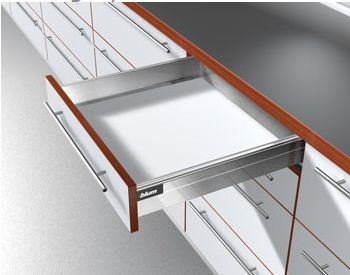
European drawer design has evolved using metal and plastic and since 1990 have become increasingly popular in North America. German innovation has brought about a different breed of drawers with space saving full extension under mount self closing non slamming push to close push to open mechanisms. Some of these are available integrated into the sides of the drawer to make an easily cleaned smooth faced combined drawer slide and drawer side.

European style drawers. 'Blum tandem box'
However the most durable drawer design is still the traditional dovetail jointed hardwood drawer. Most bespoke cabinet making companies now offer these drawers with the European under mount slide systems providing durability and function.  

Dovetail drawer with soft close under mount slides.
Another popular feature in a kitchen is a full height pantry cabinet with a combination of upper shelves and lower drawers up to almost eye level that gives much better access to items at the back of the cabinet.

Pantry with dovetail drawers on under mount slides.
Drawers may not seem to be that important to the home inspection process or the overall look of the kitchen, but they are an integral part to the overall function of the kitchen.  Considering the amount of time families spend in the kitchen, we believe having properly functioning drawers is just as important as the look of your kitchen. 


Wednesday, 25 January 2012

Project Time!

Last week we did a simple little project with two exterior doors at my Father's house.  We wanted to install glass panels into 2 standard exterior doors.  Why would we want to do this you may ask?....well to save money of course!  We saved about $200 per door doing it this way.....of course you could spend the extra money and buy a door with the glass panel already installed, but if you buy them separately you can save!  As long as you don't mind doing the work.

If you have a jig saw and some know how with tools, this is a super easy project.....All you need to do is make sure you measure your cut out for the panel correctly and get yourself some metal blades for your jigsaw.
Measure twice! cut once.


Glass panel & door.

Glass frame in 2 pieces.

Final product! Just screw the frame together.


Sunday, 22 January 2012

Home Inspection Costs

How much should a home inspection cost? This is an ongoing question and usually the first question realtors and prospective clients ask when considering our services.  

You must remember that buying a home is probably the most expensive purchase you will ever make. This is no time to shop for a cheap inspection. The cost of a home inspection is very small relative to the value of the home being inspected. The additional cost of hiring an inspector is almost insignificant by comparison.

The home inspector’s job is to provide a general, overall inspection of the home. We can consider ourselves similar to a general medical practitioner, as they would find something wrong with a patient and then send him/her to a specialist. The specialist in this case would be an electrician, plumber, roofing contractor, HVAC contractor, engineer and so forth.

You could always opt out of a traditional inspection and bring in all the expert trades to inspect your potential property, but the cost would be ridiculous! You would end up spending well over a $1000 to do this. This is why the home inspection industry exists, for a much lower fee you bring in one person who has a general knowledge of all.

You also want to make sure your home inspector is well qualified and really does know what they are doing. Do yourself a favour and pay a little more for the quality inspection you deserve.  Our prices vary for each property we inspect, don't be fooled by inexperienced inspectors offering cheap inspections.  True professionals take their job seriously and amateurs DO NOT! 
Like most things in life, you pay for what you get! 

House CSI

Building Permits


What’s the deal with building permits? Do I need one? Why do I need this? Simple answer....YES! You absolutely need them and if there are signs that your house has been worked on, you should want to know that the appropriate building permits were pulled.

During most home inspections, we can quickly figure out whether or not your home as been worked on. We can also figure out whether or not the work done has been completed by qualified trades. There will be obvious signs in workmanship that will stand out and allow us to understand what is going on. If things look sloppy and unprofessional, chances are your home could have been worked on by unqualified trades and furthermore, building permits were most likely not pulled. Permits means the work on your house has been properly prepared and completed by professionals; this also includes having the work inspected by city code inspectors as the project moves along.

People seem to associate building permits with only large expensive renovations, but it’s not the permit fee that costs the money, it’s the design fee. Properly prepared and stamped architectural drawings can cost big bucks, where the city building permits for these drawings may only cost $100-$200.

Building permits are granted by your local municipality and most municipalities differs as to which permits are required and when. Generally, you will need a permit for most renovation work, especially when it comes to removing walls and changing floor plans. You also need a permit for most plumbing, electrical and HVAC work. If you are only changing decorative finishes, you do not need to apply for a building permit.

If you suspect your home may not of had permits pulled for past renovation work, get your home inspected! Not just by a home inspector! The home inspection will give you a general report of the entire house and all its system and components, but if you think your electrical is compromised, bring in a qualified electrician! If you think your HVAC is compromised, bring in a qualified HVAC contractor!....and so forth. Your biggest concern should be the overall safety of your home. Permits are GOOD!

House CSI